Solar Panel Cleaning: When to Clean and What It Costs
Solar panel cleaning is rarely a routine job for a US home. Rain often removes ordinary dirt, but dust, pollen, bird droppings and wildfire ash can linger and reduce output. Check your system’s production and visible buildup, then compare the likely value of recovered electricity with the cleaning cost.
On this page
- Do solar panels need cleaning?
- How much energy can soiling losses cause?
- When does cleaning make financial sense?
- How often should you clean solar panels?
- How do you clean solar panels safely?
- How much does solar panel cleaning cost?
- Does cleaning affect the warranty?
- What should solar panel maintenance include?
- What do homeowners often get wrong about cleaning?
- Next steps
- Frequently asked questions
Do solar panels need cleaning?
Usually, solar panels do not need regular cleaning if rain reaches them and their production is normal. Consider cleaning when persistent buildup or monitoring data suggests a problem, rather than following a fixed schedule.
The Department of Energy says regular precipitation typically cleans panels, and light dust during a prolonged dry spell usually has little effect on performance. If panels look particularly dirty during a drought, a directed hose rinse may be enough. Read the DOE solar FAQ for its general guidance.
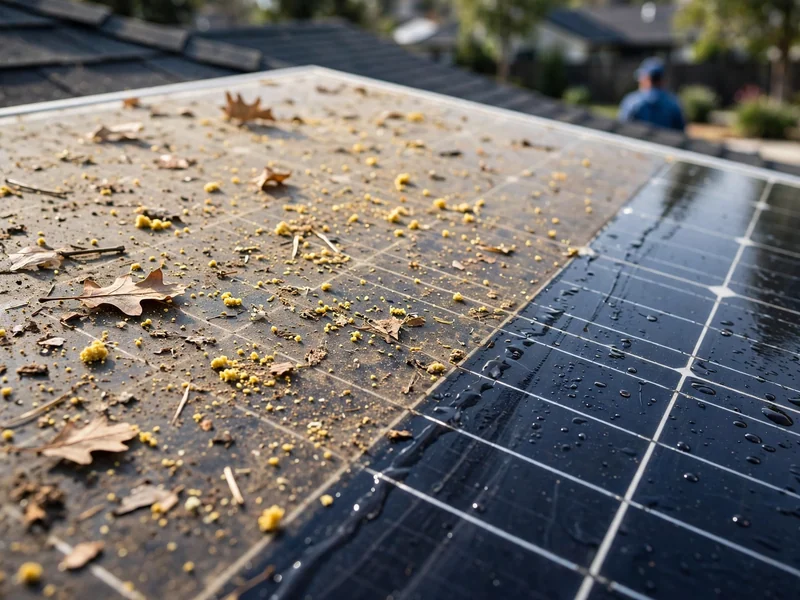
Dust, pollen and bird droppings can block sunlight, but a dirty looking panel does not prove that cleaning will pay off. Production can also change because of weather, shade, equipment faults or other issues. If you want a quick explanation of how sunlight becomes electricity, see how solar panels work.
How much energy can soiling losses cause?
Soiling losses are reductions in solar electricity caused by dirt or other material on a panel. The amount varies by site and buildup, so a national estimate cannot predict the loss for your roof.
NREL’s operation and maintenance guide reports annual losses from 4.3% to 7.5% in studies of special soiling conditions, with many studies finding losses around 6%. The guide cautions that rain affects annual results, so a homeowner should weigh cleaning against the conditions at their site. See NREL’s operation and maintenance guide.
The soiling map from the National Laboratory of the Rockies (formerly NREL) covers 255 US locations. It uses an insolation weighted soiling ratio: a ratio of 0.95 represents a 5% annual energy loss. The map offers site level data rather than one percentage for an entire climate zone, and its estimates do not fully account for pollen or biological buildup. Check the National Laboratory of the Rockies photovoltaic soiling map for location data.
| Conditions | What the research suggests | What it means for your roof |
|---|---|---|
| Areas with regular rain | Rain can remove ordinary dust, and light dust may have little effect | Watch production and clean if buildup persists |
| Dry or dusty areas | Loss depends on how much dust accumulates between rain events | Check output during prolonged dry periods |
| Local buildup such as bird droppings | A patch can shade part of a panel even if nearby glass looks clear | Check for persistent deposits and ask for advice if output changes |
These are broad patterns, not predictions for a particular home. NREL notes that the type and source of soiling matter. If dirt is one possible cause of lower output, compare it with other factors that affect solar panel efficiency. For changes over the life of a system, see solar panel lifespan and return on investment.
When does cleaning make financial sense?
Cleaning may make financial sense when the value of the electricity you expect to recover exceeds the service price. Estimate the lost energy first, then compare its value with a local quote.
Here is a worked example for an 8 kilowatt system. It assumes the system would produce 12,000 kilowatt hours in a year if clean. This annual output is an example assumption, not a prediction for every home of that size.
- Apply a 6% soiling loss, within the range of special conditions in NREL’s guide: 12,000 × 0.06 = 720 kilowatt hours lost.
- Use the US average residential electricity price of 18.16 cents per kilowatt hour reported by EIA for August 2026.
- Multiply 720 × $0.1816 = $130.75 in potential electricity value for the year.
The estimated value is below the $150 to $500 cleaning range reported by the two cost guides below. Your system’s production, utility rate and payment for exported electricity may change the result. The EIA figure is a national average, so use your own bill and utility rules for a closer estimate. Check EIA Electric Power Monthly Table 5.6.A for the published price.
For broader system economics, use a solar payback calculator after you have a reasonable production estimate. It can help put energy value in the context of overall system economics, but it does not diagnose soiling.
How often should you clean solar panels?
There is no universal schedule for cleaning solar panels. Check visible conditions and production periodically, then clean when persistent buildup or an output change gives you a reason.
Rainfall, local dust, nearby birds and wildfire ash vary from place to place. A fixed twice a year schedule may mean unnecessary work where rain keeps panels clear. In dry conditions or after heavy ash or pollen buildup, check the array and production more closely.
Compare similar seasons, such as one spring with the previous spring. If output drops unexpectedly, first look for inverter alerts, new shade or visible damage from the ground. The DOE consumer guide says a year over year production drop greater than 10% could indicate a maintenance issue, but it does not identify dirt as the cause. See the DOE guide to homes with solar panels.
If output changes suddenly, check the inverter app or display for an alert. Different solar microinverters and string inverters can affect what system monitoring shows. Do not climb onto the roof to inspect panels or wiring.
How do you clean solar panels safely?
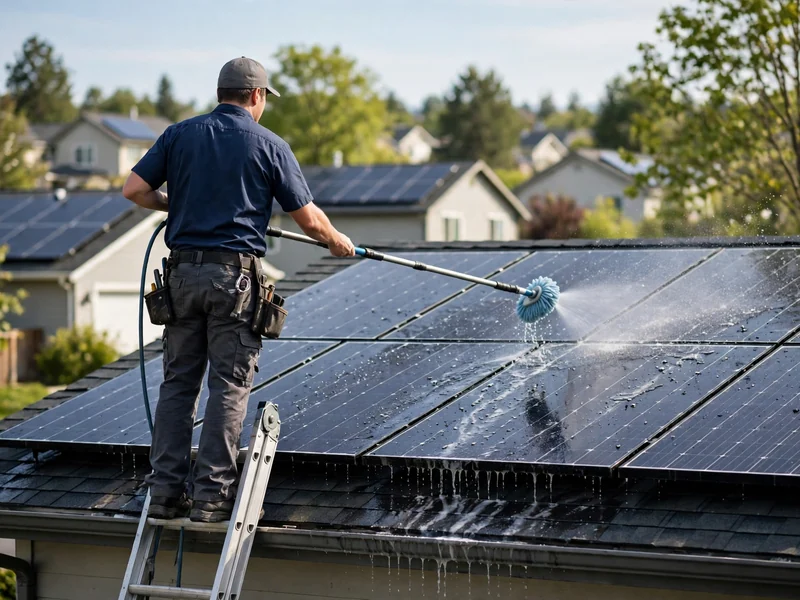
For light dirt, a gentle rinse from the ground may be enough if your panel instructions allow it. Avoid roof access, pressure washers, abrasive tools and cleaners that your manufacturer has not approved.
Check the manual for your exact panel model before cleaning. Instructions can vary. For example, the Qcells manual for a specific module series allows lukewarm water or alcohol based glass cleaner with a broom or soft cloth. It says to clean cooled modules, avoid water when frost is possible, and not to use surfactants, rotating brushes, scrapers or high pressure water equipment. The NREL guide recommends plain demineralized water and mild detergent recommended by the manufacturer. Read the Qcells installation and operation manual and follow the instructions for your own modules.
A cautious approach:
- Check your panel manual, warranty and installer instructions.
- Choose a cool time, such as early morning, and do not use water if frost may form.
- If the manual permits, rinse loose dirt with a gentle stream from a safe position on the ground.
- Use a soft brush or cloth only if the manual permits it and you can work without climbing, reaching or pressing on the panel.
- Stop if residue does not lift easily or if you see damage. Ask a qualified service provider for help.
Never walk on solar panels. Do not lean a ladder against the array or spray water at electrical equipment. Roof falls can cause serious injury, and Qcells says its cleaning should be done by qualified personnel. If roof access may be difficult, review solar roof suitability before arranging work.
How much does solar panel cleaning cost?
The two US cost guides checked for this page report professional residential cleaning prices of $150 to $500 per visit. A quote can vary with system size, roof height, access, buildup and whether inspection is included.
HomeGuide reports $150 to $500 for a typical job, while HomeAdvisor lists $200 to $500 for cleaning. These are published ranges, not a quote for your home. See HomeGuide’s solar panel cleaning cost guide and HomeAdvisor’s cleaning cost guide.
Before hiring a solar panel cleaning service, ask what the price includes, how workers will reach the panels, and what cleaning method they use. Request a written estimate and ask the provider to confirm that its method follows your panel instructions. If a company recommends repairs after only a visual check, get another assessment. This advice on solar installer red flags can help you evaluate a contractor’s claims.
Does cleaning affect the warranty?
Warranty terms depend on the panel manufacturer, the specific warranty and the cleaning method. Damage caused by an unsuitable tool or cleaner may not be covered, so check your documents before work starts.
The Qcells manual warns that improper maintenance can create safety risks or property damage. For its covered module series, it says misuse or improper maintenance voids the limited warranty. That guidance applies to those Qcells modules, not every panel brand. Read the manual and warranty for your exact model, and ask a service provider to describe its method in writing. For more on the documents to review, see solar panel warranty terms.
Do not assume that one company’s cleaning advice applies to every panel. Keep the manual, warranty and service records with your system paperwork. Your warranty may also describe who should inspect or service the equipment.
What should solar panel maintenance include?
Solar panel maintenance starts with checking production data and looking for visible changes from the ground. Routine roof access is not necessary for every system, and you should not climb up to perform a visual check.
| Check | What to look for | What to do |
|---|---|---|
| Production monitoring | Alerts or an unexplained change in output | Compare similar periods and contact your installer if output remains unexpected |
| Panels from the ground | Visible buildup, cracks or displaced parts | Ask a qualified professional to assess persistent buildup or damage |
| Roof area | New shade, branches or signs of animal activity | Arrange professional help if the issue needs roof access |
| Critter guards | Loose or damaged screening around the array | Ask an installer to assess the guard and any animal activity |
| After severe weather | Visible damage or new production problems | Have the system checked before attempting cleanup |
| Snow or ice | Heavy coverage that remains in place | Follow your panel instructions and do not climb or scrape |
The DOE says roof mounted systems have few moving parts and recommends contacting the installer if output is not as expected. For snow, its FAQ says panels often clear naturally, though conditions affect how quickly. Qcells advises removing snow or ice carefully and without force, such as with a very soft broom. Follow the directions for your equipment, and leave roof work to qualified help.
NREL identifies bird debris and nests as maintenance concerns and describes bird netting and spikes as possible mitigation options. If you see signs of animals under the array, do not try to reach beneath panels yourself. A professional can assess the issue and explain suitable options. If you notice damage after a storm, read what to do after solar panels are damaged by a hurricane. The solar glossary explains terms such as soiling ratio and kilowatt hour.
What do homeowners often get wrong about cleaning?
A common mistake is assuming that a fixed cleaning schedule or an advertised output increase proves a cleaning will save money. The result depends on the amount of persistent soiling, the value of recovered electricity and the service price.
It is also easy to mistake a system fault for dirty panels. A production change may relate to an inverter, wiring, new shade or weather. Check monitoring data and ask a qualified professional to investigate an unexpected change instead of repeatedly washing the array.
Another mistake is assuming that one manufacturer’s cleaning instructions apply to all panels. Manuals can permit different methods and materials. Check the instructions for your own model before using water, tools or cleaning products.
Finally, a national electricity price is not your personal value per kilowatt hour. Your utility bill and export credit affect the value of electricity your panels produce. Use the solar return calculator linked in Next steps with assumptions that match your utility and production records.
Next steps
Check your panel manual and production history first. If buildup is persistent, request a written quote and compare it with the value of the electricity you might recover. If you are still estimating the system’s overall economics, use a solar return on investment calculator. To compare installation costs, see the solar panel cost guide.