Voltage drop calculator: percent drop, wire size and maximum run
This voltage drop calculator shows how many volts a wire loses over a run, what percentage that is of the supply, and the voltage left at the load. Enter the system voltage, the current in amps, the one way distance in feet, the wire size and whether it is copper or aluminum. The tool also works backward: it finds the smallest wire that keeps the drop within your target, and the longest run a chosen wire can handle. A 40 amp EV charger at 240 volts, 100 feet from the panel on 6 AWG copper, loses 3.93 volts, a drop of 1.64 percent.
Check your wire run
On this page
- How the voltage drop calculator works
- Voltage drop formula and how it works
- Wire size calculator: smallest wire for your target
- The 3 percent guide: what the code actually says
- Maximum run lengths by wire size
- Long runs for solar, EV chargers and well pumps
- DC circuits: batteries and solar strings
- Permits and who should do the work
- Frequently asked questions
How the voltage drop calculator works
- Choose the systemSingle phase 120 or 240 volts for homes, DC for solar strings and batteries, or three phase for commercial supplies.
- Enter the load in ampsUse the actual current the load draws. For a circuit you are sizing, use the full breaker rating for a conservative answer.
- Enter the one way length in feetMeasure from the panel to the load along the route the wire will take, not in a straight line. The formula accounts for the return path.
- Choose conductor and wire sizeCopper or aluminum, from 14 AWG up to 4/0.
- Set your targetThe default is 3 percent, the value the National Electrical Code suggests for branch circuits.
The result shows the drop in volts and percent, the voltage at the load, the smallest wire size that meets your target, and the longest run your chosen wire can carry within it. Ready made presets load the four long run problems homeowners ask about most: an EV charger in a detached garage, a ground mounted solar array, a subpanel and a well pump.
Voltage drop formula and how it works
Every wire has resistance, so current flowing through it loses some voltage as heat. The loss grows with current and length, and shrinks as the wire gets thicker. For a single phase or DC circuit, the standard formula is:
Voltage drop = 2 × K × I × L ÷ CM
- K is the resistance constant of the conductor: about 12.9 ohms per circular mil foot for copper and 21.2 for aluminum, at typical operating temperature.
- I is the current in amps.
- L is the one way length in feet; the 2 accounts for the wire out and back.
- CM is the wire's cross section in circular mils, from NEC Chapter 9, Table 8.
For three phase circuits, replace the 2 with 1.732, the square root of 3.
A 40 amp EV charger at 240 volts, 100 feet away on 6 AWG copper (26,240 circular mils): 2 × 12.9 × 40 × 100 ÷ 26,240 = 3.93 volts. Divided by 240, that is 1.64 percent, leaving 236.1 volts at the charger.
The calculator uses these constants and the Chapter 9 areas for every size. It ignores reactance, which matters only for large conductors in steel conduit at high currents, and it treats the conductor as running warm, which gives a slightly conservative answer.
Wire size calculator: smallest wire for your target
To find the right wire, the tool solves the formula for circular mils: CM = 2 × K × I × L ÷ allowed drop in volts. It then picks the next standard size up.
Using the same EV charger example with a 3 percent target, the allowed drop is 7.2 volts, so the wire needs at least 2 × 12.9 × 40 × 100 ÷ 7.2 = 14,333 circular mils. That points to 8 AWG copper at 16,510 circular mils, which gives a drop of 6.25 volts, or 2.60 percent.
Voltage drop is only half of wire sizing. The wire must also carry the current safely, which the code sets in its ampacity tables. For a 40 amp continuous load like an EV charger, the circuit is sized at 125 percent, so 50 amps, and the conductor must be rated for that. The tool checks copper sizes against the 75 degree column of NEC Table 310.16 and flags any wire too small to carry the current, whatever its voltage drop. For aluminum, and for anything unusual, confirm sizing with a licensed electrician.
The 3 percent guide: what the code actually says
Most voltage drop tools present 3 and 5 percent as legal limits. They are not. In the National Electrical Code, the figures appear in informational notes to sections 210.19, for branch circuits, and 215.2, for feeders. The notes suggest sizing conductors so the drop is no more than 3 percent on a branch circuit or feeder and no more than 5 percent for feeder and branch circuit combined. Informational notes are explanatory material, not enforceable requirements.
That matters in two ways. First, a long run that comes in at 3.5 percent is not a code violation, and an inspector will not fail it for that reason alone, unless your local jurisdiction has adopted a stricter rule. Second, the guide values still make good engineering sense. A large drop wastes energy as heat, makes motors run hotter and start harder, and can make sensitive equipment misbehave. A few places in the code do set enforceable voltage drop limits, such as for fire pumps, but ordinary home circuits are not among them.
Use 3 percent as a performance target. Go lower for motor loads and long solar runs, where every lost volt is lost energy.
Maximum run lengths by wire size
This table shows the longest one way run, in feet, that keeps the drop at or below 3 percent when the circuit carries its full rated current on copper wire.
| Circuit | Copper wire | Max run at 120 V | Max run at 240 V |
|---|---|---|---|
| 15 amps | 14 AWG | 38 feet | 76 feet |
| 20 amps | 12 AWG | 46 feet | 91 feet |
| 30 amps | 10 AWG | 48 feet | 97 feet |
| 40 amps | 8 AWG | 58 feet | 115 feet |
| 50 amps | 6 AWG | 73 feet | 146 feet |
| 60 amps | 4 AWG | 97 feet | 194 feet |
These are conservative figures. Most circuits carry well under their rating most of the time, and at 80 percent of rated current each distance grows by 25 percent. A 240 volt circuit carries the same power at half the current of a 120 volt one, which is why 240 volt runs can be twice as long for the same percentage drop.
Long runs for solar, EV chargers and well pumps
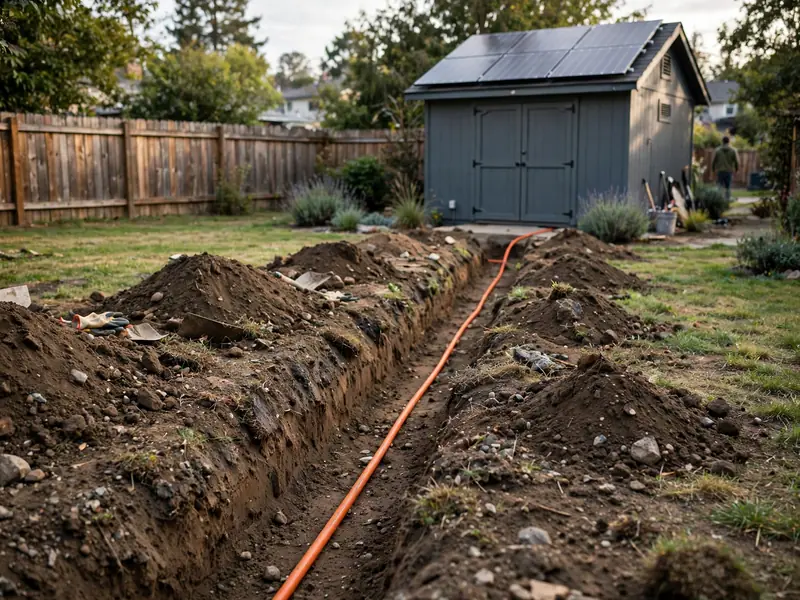
A 40 amp charger at 240 volts, 100 feet away: 8 AWG copper gives 2.60 percent and 6 AWG gives 1.64 percent. Many electricians choose 6 AWG anyway, both for the lower drop and to leave room for a larger charger later. Our guide to EV charger installation cost covers how wire runs affect the price.
A 7.6 kW inverter delivers about 32 amps at 240 volts. Over a 200 foot run, 6 AWG copper loses 6.29 volts, 2.62 percent, and 4 AWG loses 3.96 volts, 1.65 percent. On a solar run, the drop is energy lost every sunny hour for 25 years, so a larger wire often pays for itself, and it can also keep the inverter within its voltage window on hot afternoons. Where the inverter sits relative to the array affects this as well; our comparison of microinverters and string inverters explains the wiring differences, and our guide to solar roof suitability covers when a ground mount makes sense at all.
A 60 amp subpanel at 240 volts, 150 feet away: 6 AWG copper gives 3.69 percent, 4 AWG copper gives 2.32 percent, and 2 AWG aluminum, a common feeder choice, gives 2.40 percent. If you are adding a subpanel for new loads, a smart electrical panel is another way to manage capacity.
A pump drawing 10 amps at 240 volts, 300 feet from the panel: 12 AWG copper loses 4.94 percent, 10 AWG 3.11 percent and 8 AWG 1.95 percent. Pumps start with a surge several times their running current, so a drop that looks fine while running can be much worse at start up. A pump that struggles to start or trips on a long thin wire is a classic voltage drop problem.
DC circuits: batteries and solar strings
DC circuits use the same formula with the 2 multiplier. Solar strings run at several hundred volts, so their percentage drop is usually small. Low voltage systems are the opposite: at 12 volts, a 3 percent drop is only 0.36 volts, so a short run of thick cable can already reach the limit. The calculator handles 12, 24 and 48 volt DC, but vehicle, marine and RV wiring follow their own standards, and this page focuses on home circuits. For portable backup systems, see our guide to a solar generator for home backup.
Permits and who should do the work
Running a new circuit, feeder or solar connection almost always needs an electrical permit and an inspection, and in many states a licensed electrician. The calculator helps you understand a quote and ask good questions, such as why an electrician proposes 6 AWG for a run where 8 AWG would carry the current. It does not replace a load calculation or a site check. Our guides to solar permitting by state and to whether DIY solar installation is legal explain the rules, and the heat pump installation permit guide covers the same question for a new 240 volt heat pump circuit. For other home energy tools, see our calculators.